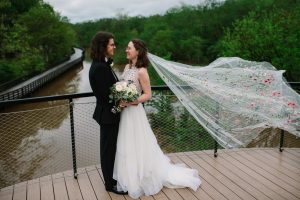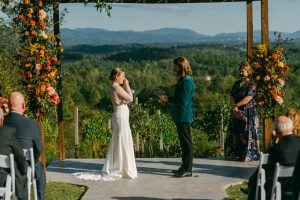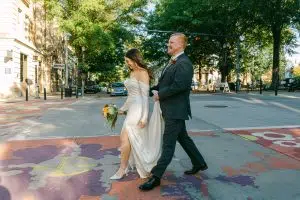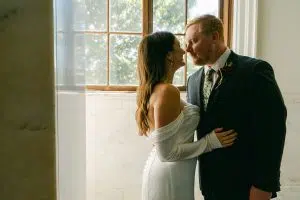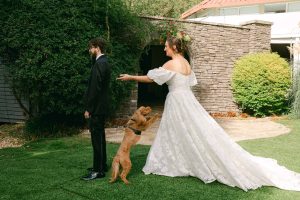

I want to tell you about the moment Rowan turned to me in the middle of the Villa d’Este gardens — surrounded by moss-covered sculptures, enormous fountains, and light that didn’t look real — and just gestured broadly at everything around us with an expression that said can you freaking believe this? I could not. We did that approximately fifteen times throughout the afternoon, because every corner of that place earned it.

This was the day before Rowan & Kelsey’s elopement at a private villa in Fregene. And the day after the wedding, the three of us drove to Florence together — Boboli Gardens, Pitti Palace, the Duomo, long lunches, a loose list of places we wanted to hit and the freedom to ignore it whenever something better came along.
Three days. Two exploration sessions. One elopement in the middle.
It’s the smartest way I’ve ever seen a couple approach a destination wedding trip, and I want to tell you exactly how they did it.
As a documentary photographer, the pre-wedding portrait session is one of my favorite things to build into an international elopement — but what Rowan & Kelsey understood is that it doesn’t have to stop there. You’ve traveled this far. You’re in one of the most beautiful countries in the world. You’re not in wedding mode yet — you’re in traveler mode, curious and unhurried and genuinely just happy to be there. That energy is irreplaceable in photographs. And it doesn’t have to end when the ceremony does.


My Advice for Building an Italy Elopement Trip Like This
Leave unscheduled time in your itinerary — genuinely unscheduled. Rowan & Kelsey built intentional gaps into their trip before they left home. Not vague gaps with backup plans — actual open space. That’s what made the Villa d’Este session possible. That’s what made Florence possible. If every hour is accounted for before you board the plane, you’ll spend the whole trip executing a plan instead of actually being somewhere.
Do your portrait session before the wedding day. By the time Rowan & Kelsey’s elopement morning came, we’d already spent hours together in the gardens at Tivoli. The camera was completely invisible to them — not because they’re unusually comfortable in front of one, but because we’d already broken that in. It matters enormously in the photographs.
Keep exploring after the wedding too. The day after the elopement, we drove to Florence together. No formal shoot — I was just there, documenting the day as it happened. We went to Boboli Gardens, walked through Pitti Palace, stood in front of the Duomo, ate well, wandered. Some of my favorite images from the entire trip came from that day, precisely because nobody was thinking about making photographs.
Go on weekdays wherever possible. The Villa d’Este gardens were quiet when we were there. Florence is never truly quiet, but a relaxed weekday pace is a different experience than weekend crowds. If your timeline has any flexibility, it’s worth building around.
Think about what you’re wearing throughout the trip. You might be in a wedding dress one day and linen trousers the next, in a formal Renaissance villa one afternoon and a street market the following morning. What you bring needs to work across all of it. My September Italy packing guide covers this in detail, and if you’re traveling with a dress, my guide to traveling with your wedding dress is essential reading before you pack.


Plan Your Italy Pre Wedding Photography Trip
The framing I’d encourage you to start with is this: instead of thinking about your elopement as a single day you’re traveling to Italy for, think about it as the center of a longer experience. The wedding day is the anchor. Everything around it — the exploration, the meals, the discoveries, the portrait sessions in extraordinary places — is part of the same trip, and part of the same story.
This structure also does something practical for your photography: it distributes the pressure. Rather than asking one day to hold every meaningful image you’ll ever have from Italy, you spread that across three or four days of real experience. The wedding day gets to be more documentary and relaxed. The portrait sessions get to be more adventurous. And the candid moments in between — Rowan talking to the chefs in Italian, all of us standing in front of the Duomo slightly overwhelmed by it — get documented too, because I’m there for the whole thing.
For the logistics of pulling this off — legal requirements, timeline planning, vendor sourcing, what to actually figure out and in what order — my Italy elopement planning guide covers it all.


Day One: Villa d’Este, Tivoli
To be clear about which Villa d’Este we’re talking about: this is the Renaissance villa and garden complex in Tivoli, about 30 kilometers east of Rome — not to be confused with the luxury hotel on Lake Como that shares the name. The Tivoli Villa d’Este is a UNESCO World Heritage Site, built in the 16th century, and it is one of the most extraordinary places I have ever stood.
The gardens are terraced down a hillside, with hundreds of fountains fed by a system of channels and aqueducts that has been running for over four centuries. There are moss-covered sculptures, long reflecting pools, hidden grottoes, enormous jets of water that you hear before you see them. The views from the upper terraces look out over the surrounding hills and the town below. The villa interior — painted ceilings, arched windows that frame the gardens like paintings — is stunning in its own right.
As soon as we arrived, Rowan & Kelsey just started exploring. That’s the only way to do it. You can’t plan a route through a place like that — you follow what catches your attention and trust that everything is worth seeing. We ended up at Villa Gregoriana as well before the light was gone — waterfalls, Roman ruins, caverns that were dramatic in a completely unexpected way. It was the best possible first day in Italy, and it set the tone for everything that followed.
Where to shoot at Villa d’Este for italian wedding photos:
The upper terraces offer sweeping views and beautiful late-afternoon light — ideal for elevated, open portraits with the gardens cascading behind. The long fountain walkways create natural leading lines and real depth. The villa interior, with its painted rooms and afternoon window light, is some of the best natural light I’ve worked in anywhere. The lower gardens are more textured and shaded — moss, stone, the feeling of genuine age — and work beautifully for quieter, more intimate frames. And if you have time, Villa Gregoriana afterward gives you a completely different visual environment: wilder, more ancient, dramatic in a way that contrasts beautifully with the formal Renaissance gardens.


Day Two: The Elopement in Fregene
The wedding itself was the following day — a private villa in Fregene, a small beach town about thirty kilometers west of Rome. Pink walls, a courtyard full of trees and flowers, close friends and family who had traveled to be there, private chefs, handwritten vows, and an evening that ended with a long dinner and stories from locals about life in Italy.
Because we’d already spent real time together at Villa d’Este, the wedding day had a completely different quality to it. Everyone was settled into the trip. The nervousness that sometimes sits under a wedding morning wasn’t really there — or if it was, it was the good kind. Rowan & Kelsey had already had a beautiful day in Italy together. The wedding was the next one.
You can read the full story of their elopement here.


Day Three: Florence
The day after the wedding, we took the train to Florence.
There was no formal session planned — I was just there, camera in hand, documenting whatever the day turned into. We went to Boboli Gardens, walked through Pitti Palace, made our way to the Duomo, ate, wandered, followed whatever looked interesting. It was the most relaxed day of the trip in the best possible way — everyone still riding the high of the elopement, nobody with anywhere particular to be, just a group of people exploring one of the world’s great cities together.
Some of my favorite moments from the entire trip came from that day. Not because the locations weren’t extraordinary — they were — but because of the quality of attention everyone brought to it. When you’re not performing anything, not trying to make anything happen, just actually present somewhere, the photographs reflect that completely. You can feel it in them.
This is what I mean when I say the wedding doesn’t have to be the only thing. Florence the day after Rowan & Kelsey’s elopement wasn’t a bonus or an afterthought. It was part of the same story — and the images prove it.


FAQs About Italy Pre Wedding Photography
How far is Villa d’Este from Rome? About 30 kilometers east — roughly an hour by car depending on traffic, or accessible by train and bus from Tiburtina station. We drove, which gave us flexibility with timing and made the trip itself part of the day.
Is Villa d’Este in Tivoli open to the public? Yes, it operates as an Italian state museum with standard entry fees. No special permits are required for personal photography, though commercial shoots may have different requirements. Check current policies before your visit as they can change seasonally.
What time of year is best for a pre-wedding portrait session in Italy? Late spring through early autumn gives you the best weather, though summer crowds can be significant at popular sites. September was ideal for us — warm, dry, and relatively quiet at Villa d’Este. My September Italy packing guide covers what to expect in terms of weather, light, and what to wear.
Can I do a pre-wedding session before my elopement and keep exploring after? Yes — and based on what I saw with Rowan & Kelsey, I’d encourage it strongly. The structure of having intentional exploration days on either side of the wedding changed the quality of the entire trip. Nothing felt rushed. Everything felt like part of the same experience.
How do I get my wedding dress to Italy? Carry it on. My wedding dress travel guide covers the full strategy — how to pack it, what to do when you arrive, how to handle connections through multiple airports.
How do I find an italy elopement photographer who will actually travel with us like this? Look for someone who talks about travel the way they talk about photography — with genuine enthusiasm, not just willingness. The photographers who do this well aren’t just showing up for the wedding day. They want to be part of the trip. My Italy elopement guide has more on what to look for when hiring for a destination elopement.
What should I wear for italian wedding photos at a historic site? Think about the textures and tones of the location — Renaissance stone, garden greenery, terracotta and water. Softer colors and natural fabrics tend to complement these environments rather than compete with them. Avoid anything too stiff or formal that you wouldn’t actually be comfortable exploring in for several hours. My September Italy packing guide goes into specifics.


Let’s Build Your Italy Elopement Trip
I’m based in Atlanta and travel internationally for elopements and portrait sessions — and trips like this one, where the wedding is the anchor and the whole experience is the point, are my absolute favorite thing to be part of.
If you’re planning an italy elopement and want to think about it as a full trip rather than a single day, get in touch here and let’s talk about what that could look like for you.